Structural Versus Interactive Complexity
Broadly speaking, systems fall into two categories: structurally complex and interactively complex. Why should Marines understand the difference between these two types of systems? Because we typically apply problem-solving approaches appropriate for structurally complex systems to interactively complex systems and become frustrated when our efforts are ineffective or even make things worse.
During most tactical training, we present young leaders with problems which have a definite solution. “The enemy force is there. Attack to destroy them.” This approach is easy to evaluate and has the apparent advantage of permitting progressive training (allowing the individual or unit under training to “master” basic tasks before moving on to those of greater complexity). Unfortunately, modern conflicts rarely provide the simplicity modeled in most training. The result is units — and leaders — who are unprepared for the challenges they face or feel as though they need to “throw out the book” to succeed on the battlefield.[1]
There is an education gap which contributes to this training shortfall. Marines approach every problem as a product of a structurally complex system when most problems they face come from interactively complex systems. We often try to apply relatively simple and straightforward problem-solving techniques (and their resulting solutions) applicable to structurally complex systems to interactively complex systems and are surprised when the outcome is not as expected. Structurally complex systems have very different characteristics, behave very differently than interactively complex systems, and require very different problem-solving approaches. Military professionals must know what type of system they are dealing with to develop an effective course of action.
The table below captures several of the significant differences between these two different types of systems.
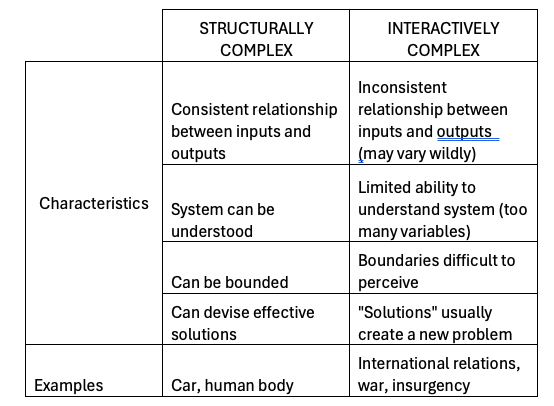
Structurally complex systems are not easy to understand, but because inputs and outputs remain consistent, we can make sense of them and develop reasonable solutions. If you do not put gas in your car, at some point it will stop running. If the human body is deprived of oxygen, death will occur in a matter of minutes. While there are some variables which can affect how long it takes to run out of gas or die from lack of oxygen, without additional inputs (gas or air), the outcome is certain, predictable, and not subject to change.
Interactively complex systems behave in an entirely different manner. Actions may have entirely unexpected (and unintended) consequences. The relationship between inputs and outputs is inconsistent. The problems which result from interactively complex systems are usually called “wicked problems.” Wicked problems are intractable and usually do not have solutions; any energy applied to the system simply results in a new problem state.[2]
International relations is an interactively complex system. Who expected the fall of the Berlin Wall in November 1989? Or the collapse of the Soviet Union a couple years later? What about the terrorist attacks of 11 September 2001? Such surprising events are occasionally referred to as “black swans.” They are spawned by interactively complex systems.
Although Carl von Clausewitz did not use the terms interactively complex system or wicked problem, his understanding of war is consistent with these terms. It was Clausewitz who wrote, “War is more than a true chameleon that slightly adapts its characteristics to a given case.”[3] Clausewitz viewed war as a complex phenomenon which required a great deal of intellectual effort to develop even a partial understanding of the subject. Because Clausewitz succeeded in capturing insights on war as a phenomenon of human behavior, On War is still valuable (despite its shortcomings).
What does this differentiation between structurally complex and interactively complex systems mean for Marines? First, it is important to know what kind of system you are dealing with before you attempt to develop a course of action. Second, Marines must view wicked problems as holistically as possible. You may not be able to develop an all-encompassing understanding of the problem, but intentionally oversimplifying the challenges you face is a good first step on the road to disaster. Third, understand that some problems cannot be solved. Your actions will only result in a new problem state. The object in such cases is for our actions to achieve “better” circumstances rather than to make things worse.[4]
Marines tend to view every system as structurally complex. It is beguiling (and a sign of intellectual arrogance) to believe that we can understand any system if we just have a little more information. We often act as though there is some golden key which will unlock the mystery. We just need to seek it out or wait for this piece of data to fall into our lap.
Even those who ought to know better fall into this trap. For instance, “After General David Petraeus assumed command of American forces in Afghanistan in June 2010, he proclaimed that after nearly nine years of war in Afghanistan the United States had finally gotten its ‘inputs right.’” Like many others (General McChrystal and his staff had also previously referred to having the “right inputs” in Afghanistan), Petraeus viewed war as a structurally complex system rather than an interactively complex system.[5] Get the inputs right and the outputs should follow. While this may work for a structurally complex system, there are no guarantees for an interactively complex system such as war, as subsequent events (2010-2021) in Afghanistan clearly demonstrate.
When dealing with wicked problems, Marines must accept that they will almost certainly have to make decisions without all the information they need. While Marines may be comfortable making decisions with incomplete information, most training excludes the complicating factors they will face in the future (free-thinking enemy, civilians). Marine Corps training could benefit from de-emphasizing Training & Readiness (T&R) Manual tasks and focusing on developing leaders at all levels who are agile thinkers. If training is preparation for certainty, education is preparation for uncertainty. While both training and education are essential, they must be more closely aligned to ensure future success.
The difference between structurally complex systems and interactively complex systems is more than an intellectual exercise. Each system behaves differently and requires a different approach if leaders are to develop an effective course of action. The Marine Corps’ training focus on T&R tasks means leaders will continue to find themselves unprepared when faced with complex wicked problems. Changes to training and education are necessary to ensure the Marine Corps succeeds on the future battlefield.
[1] I believe Marine leaders who succeed in combat (or in other challenging and stressful environments) often do so despite their training rather than because of it. This is particularly true given the emphasis on techniques and procedures (with little, if any, attention paid to developing the ability to think tactically).
[2] There is an interesting irony here. Applying the same failed solution to a problem in a structurally complex system will fail every time while repeatedly doing the same thing for a wicked problem could have a different (although not necessarily better) outcome.
[3] Carl von Clausewitz, On War, ed. by Michael Howard and Peter Paret (Princeton: Princeton University Press, 1984), 89.
[4] One thing I have learned: no matter how bad things seem, they can always get worse. There are a lot of cases (particularly where non-combatants may be involved where “First do no harm” may be a helpful guideline to keep in mind.
[5] Gian Gentile, Wrong Turn: America’s Deadly Embrace of Counter-Insurgency (The New Press, 2019), 1. For General McChrystal, op. cit., 129.